A small radio in every wheel
Why US cars have had tire sensors since 2007, what each packet contains, and why parked cars are usually quiet.
THE EXPERIMENT BEHIND THE REEL
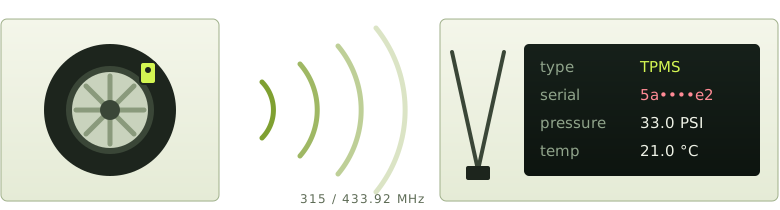
The tire pressure sensors in most modern cars broadcast a serial number that never changes. Here’s what they send, what that does and doesn’t reveal, and how to check your own car with a $30 radio.
WHAT’S INSIDE
A readable guide and a small kit, with the limits left in.
Why US cars have had tire sensors since 2007, what each packet contains, and why parked cars are usually quiet.
What the 2010 research found, how far a receiver can hear, and what a serial can and can’t tell anyone.
Run the logger on sample data with no radio, then on your own car with an RTL-SDR. Serials stay masked by default.
From inside a closed garage, the radio decoded tire packets from a Toyota and a Ford passing nearby. My own car, a Tesla, never showed up: newer Teslas use Bluetooth sensors that this radio can’t receive. The guide explains how to tell which kind your car has.
No radio is needed to read the guide or run the kit on its sample data. Listening to your own car takes an RTL-SDR (about $30), an antenna, and the free rtl_433 decoder. The logger uses standard Python with nothing extra to install.
No. It only reads what rtl_433 decodes, and it never transmits. Serial numbers are masked by default, and the guide asks you to record only your own vehicle and never use it to follow anyone.
There isn’t one to wait for. After you enter your email, the reading and download links appear right here. They expire after 15 minutes; use “Get fresh links” to renew them. This request does not subscribe you to a newsletter.